

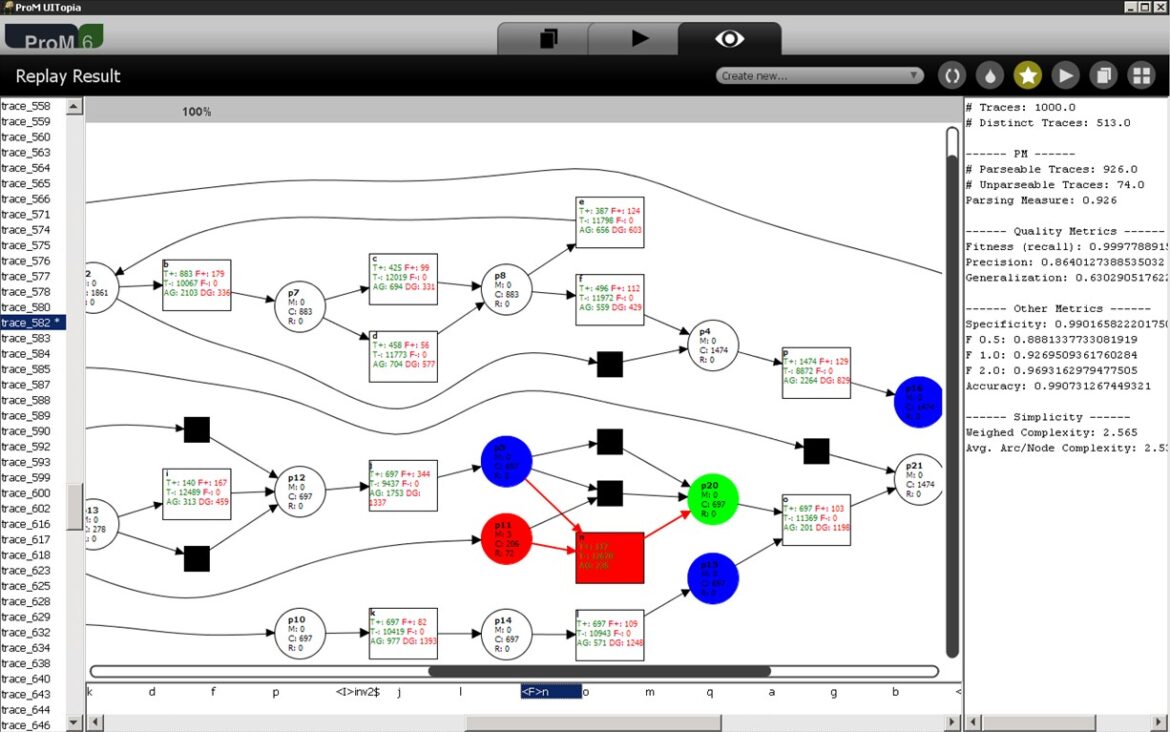
In the world of data and digital workflows, imagine a symphony orchestra performing a complex piece. Each musician follows a score — the ideal composition that defines how every note should unfold. Yet, even the most disciplined orchestra might drift: a violinist plays too softly, a drummer comes in a beat late. The conductor’s job is to notice these deviations and bring harmony back. In data-driven organizations, the A Priori Process Model plays the role of that musical score, while conformance checking acts as the vigilant conductor ensuring the performance aligns with the ideal plan.
This article unravels how an A Priori Process Model serves as the backbone of process mining and why its pre-defined structure is indispensable for diagnosing real-world process deviations.
1. The Blueprint Before the Journey: Understanding the A Priori Process Model
Before a project or workflow is executed, teams often design an “ideal” version of how activities should flow — a process blueprint. This is the A Priori Process Model: the pre-defined ideal representation of how things are meant to happen.
Think of it as a GPS navigation system that outlines the perfect route before the car even moves. Once the trip begins, the actual journey may differ — detours, stops, or missed turns. Similarly, in organizational workflows, deviations may occur between the ideal (the model) and the real (the event log). Conformance checking compares the two, pinpointing where practice diverges from theory.
For learners exploring a ba analyst course, understanding this relationship is crucial. It teaches how to use data traces from real operations to measure adherence to expected behavior — a skill that bridges theory with analytics-driven performance improvement.
2. When Reality Challenges Design: The Heart of Conformance Checking
Every business process — from order fulfillment to loan approvals — follows a logic. But people, systems, and external pressures often cause it to wander off-script. Conformance checking identifies whether actual process execution matches the predefined model and where discrepancies lie.
For instance, in a financial institution, the A Priori Process Model for loan approval might dictate: application → verification → approval → disbursal. But logs may reveal cases where verification is skipped, or approvals happen before documentation. Such deviations are not mere errors; they are clues to inefficiency, risk, or even compliance violations.
Students in a business analyst course often encounter this concept in process mining modules, where algorithms like token replay or alignment-based conformance checking are used to quantify the “fit” between model and reality. This quantitative insight transforms vague assumptions into measurable discrepancies — helping analysts recommend grounded improvements.
3. Case Study 1: A Hospital’s Quest for Diagnostic Precision
At a metropolitan hospital, administrators implemented a new digital patient pathway for diagnostic imaging. The A Priori Process Model was clear: referral → scheduling → imaging → reporting → patient follow-up. However, event logs painted a different story — nearly 15% of patients had delayed reports due to bottlenecks in the “imaging” phase.
Through conformance checking, analysts traced these lags to machine downtime and manual data entry errors. Armed with insights, the hospital introduced automated scheduling and machine health monitoring. Within months, diagnostic turnaround improved by 22%.
This example underscores how an ideal model is not meant to police employees — it’s a mirror reflecting where reality falters and systems need reinforcement.
4. Case Study 2: Manufacturing and the Assembly Line Anomaly
A major electronics manufacturer relied on an A Priori Process Model to monitor assembly workflows. The ideal process dictated a sequential flow of component fitting → soldering → testing → packaging. Yet the conformance analysis revealed something unexpected: certain units bypassed testing altogether before packaging.
Upon investigation, analysts discovered that during peak demand, operators skipped testing to meet delivery deadlines. What appeared as a process deviation was a signal of workforce overload.
By recalibrating schedules and introducing parallel testing stations, the company restored process integrity and reduced warranty claims by 12%. Such case studies often feature in ba analyst course curricula to show how analytical reasoning turns process mining outputs into actionable strategy.
5. Case Study 3: The Bank that Found a Hidden Loop
In a retail bank, the A Priori Process Model for credit card activation was straightforward — application → verification → activation. But conformance checking revealed a peculiar loop: some applications cycled between verification and documentation repeatedly.
Further analysis exposed a loophole in document validation scripts that forced customers to resubmit forms multiple times. Fixing this glitch not only reduced processing time by 35% but also improved customer satisfaction scores dramatically.
This story exemplifies how the A Priori model becomes a diagnostic compass — guiding business analysts to the root of operational friction rather than its surface symptoms.
6. The Human Touch in Algorithmic Conformance
While algorithms perform the heavy lifting, interpretation remains an art. Business analysts bring contextual intelligence to the data — understanding that not all deviations are bad. Some represent necessary flexibility, innovation, or adaptation.
A business analyst course emphasizes this nuance — learning when to enforce the ideal model and when to evolve it. The A Priori Process Model, therefore, is not a static artifact but a living hypothesis, continuously refined as organizations learn from their deviations.
Conclusion: From Ideal to Insight
The A Priori Process Model is more than a digital blueprint; it’s a philosophical statement about how we believe work should happen. But the real magic begins when organizations dare to compare that belief with reality. Conformance checking, in essence, is the dialogue between expectation and execution.
Just as a conductor brings harmony to a symphony by aligning musicians to the score, a business analyst aligns organizational processes with the model’s rhythm. Through this interplay, efficiency is not just measured — it’s orchestrated.
For professionals mastering process mining, whether through a ba analyst course or a business analysis course, understanding the A Priori Process Model means learning to bridge design with reality — and turning process data into a story of continuous improvement.
Business Name: ExcelR- Data Science, Data Analytics, Business Analyst Course Training Mumbai
Address: Unit no. 302, 03rd Floor, Ashok Premises, Old Nagardas Rd, Nicolas Wadi Rd, Mogra Village, Gundavali Gaothan, Andheri E, Mumbai, Maharashtra 400069, Phone: 09108238354, Email: enquiry@excelr.com.